Common, and famous
Around 68 million Penny Blacks were printed between May 1840 and early 1841, and a great many survive. A used example is not rare. What makes one worth £60 and another £6,000 is a short list of features that anyone with a magnifying glass can check.
The margins
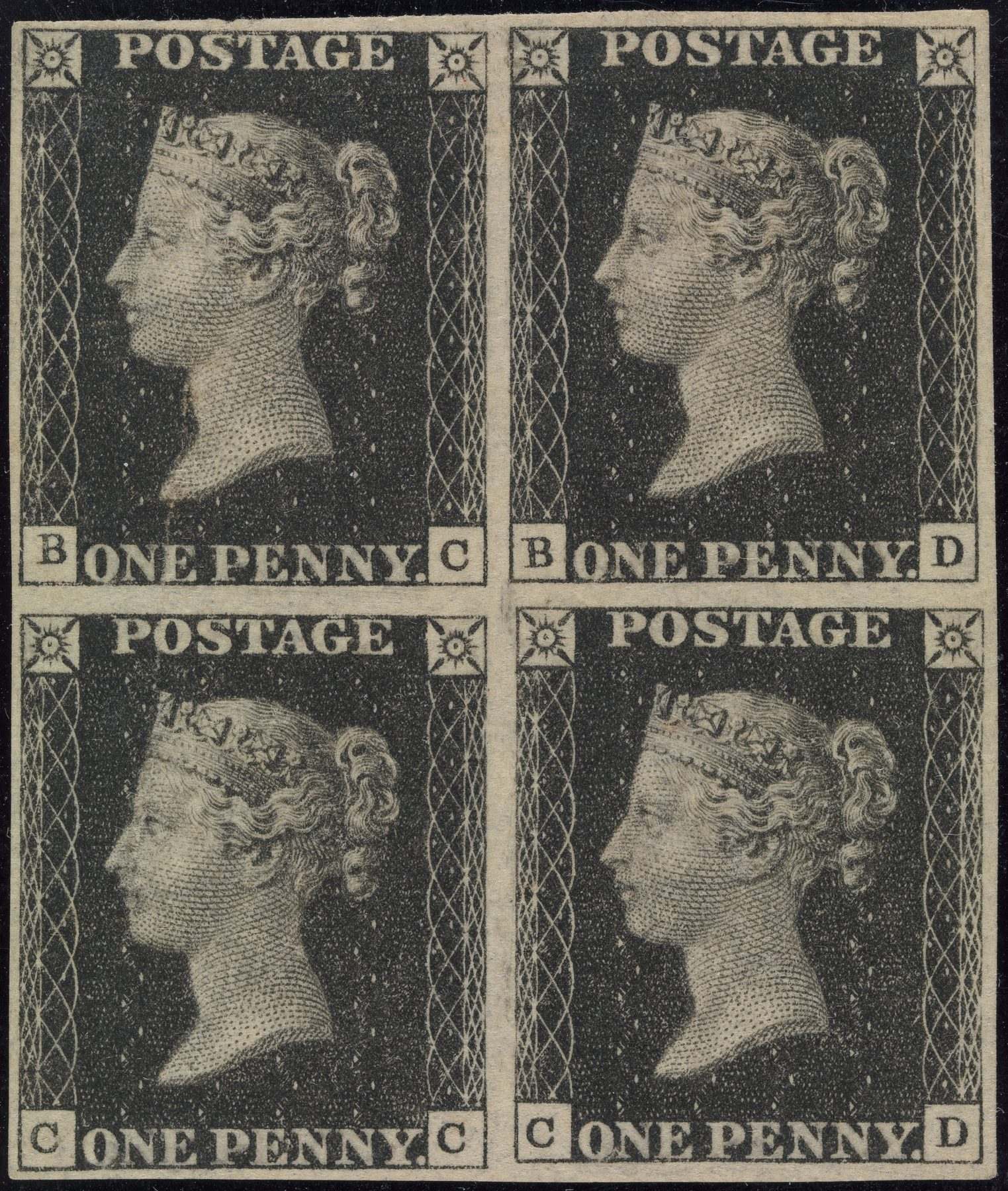
Penny Blacks were printed in sheets and cut apart with scissors, since perforation came later. The gap between stamps was small, so most surviving copies have at least one margin cut into the design. The trade counts margins, and the price steps up with each one.
| Margins | Typical used price |
|---|---|
| Cut into on two or more sides | £30 to £80 |
| Three clear margins | £80 to £150 |
| Four clear margins | £150 to £350 |
| Four large margins, even | £350 and up |
These are illustrative ranges for a sound copy of a common plate. The price records show recent hammer prices.
The plate
Eleven printing plates were used, numbered 1 to 11, with plate 1 in two states, 1a and 1b. Plates 1 to 10 are all common enough. Plate 11 was made when the black stamp was being replaced by the Penny Red, printed a small number in black, and is scarce. A plate 11 Penny Black with four margins sells for thousands. Plating a stamp takes a reference book and practice, since the differences are small, but a dealer or auction house will do it for a consignment.
The letters
Every stamp carries two letters in its lower corners that give its position on the sheet, from A-A to T-L. They do not change the value except in one way: they let a stamp be identified and, if stolen, recognised.
The cancel
Penny Blacks were cancelled with a Maltese cross, struck in red ink at first and in black from February 1841. A clear red cross that leaves the profile visible is what collectors want. A heavy black cross, a smudged strike or a later pen cancellation lowers the price. A stamp on its original envelope, or “on cover”, with a readable date, sells for more than the stamp alone, and the first day covers guide puts a range on the 1840 covers.
Condition
Thins, where paper has been lost from the back, tears, creases and repairs each take a large proportion off. Hold the stamp to the light to look for thins. A stamp described as “faults” or “spacefiller” is priced at a fraction of a sound one.
Unused copies
A Penny Black with its original gum and no cancel is rare, since almost every one was used for postage. Genuine unused examples with four margins have made five-figure sums. Many “unused” stamps are cleaned used copies with the cancel removed, which is why unused copies need a certificate from an expertising committee before anyone will pay the price.
What to do with one
Do not remove it from an envelope. Do not try to clean it. Put it in a stock card and have a dealer or saleroom plate it and grade it. The collection guide covers what to do with the album it came in.